Education and Learning


In an age of constant screens, digital note‑taking, and artificial intelligence, handwriting may seem outdated. Yet neuroscience, education research, and cognitive psychology all agree on one point: writing by hand remains one of the most powerful tools for learning, memorizing, thinking, and creating.
Unlike typing on a keyboard, handwriting engages the body, the mind, and emotions in a single movement. The choice of pen—whether it’s a ballpoint, rollerball, or fountain pen—also plays a key role in this writing experience. At Pilot, writing is far more than a functional gesture: it is a cognitive experience, a direct link between an idea and its expression.
Here are 10 essential benefits of handwriting, scientifically demonstrated for both children and adults.
To learn more about our commitment to this topic and discover our dedicated advice, visit our page focused on mental health, including resources on handwriting for memory.
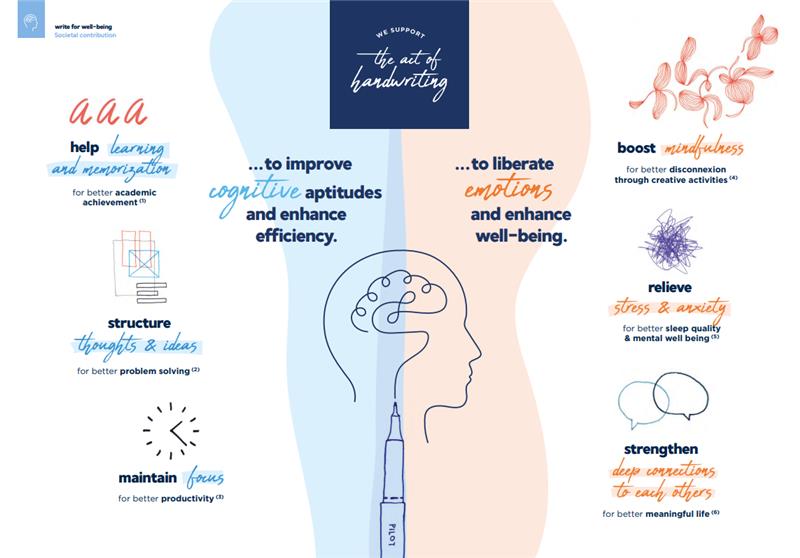
Writing by hand forces the brain to process information, reformulate ideas, and select what matters most. This cognitive effort promotes deeper knowledge encoding, making handwriting for memory and learning especially effective.
A study from Princeton University shows that people who take handwritten notes achieve better results in comprehension and memorization than those using a computer. Information retention can increase by 20 to 30%, depending on the type of content.
Handwriting activates several areas of the brain simultaneously:
Brain imaging studies (fMRI, EEG) show richer neural activation during handwriting compared to typing, promoting learning and brain plasticity at any age.
Writing by hand creates a slower, more intentional rhythm. While digital tools encourage multitasking, handwriting promotes sustained attention.
Research shows that:
This makes handwriting a particularly effective tool for students, professionals, and anyone seeking better concentration.
The contact with paper, the freedom of movement, and the ability to draw, cross out, or switch colors stimulate divergent thinking.
Cognitive psychologists link handwriting to more fluid creativity, because it frees thinking from the rigid structure of digital tools.
The mind map is one of the most effective tools derived from handwriting.
It helps to:
Mind maps are ideal for learning, organizing projects, or clarifying complex ideas.
Mind mapping is an information visualization technique that represents ideas in a graphical format called a mind map. It presents thoughts in a visual structure.
Creating a mind map helps organize ideas within a single document, representing information in a tree-like structure.
For children, handwriting plays a fundamental role in cognitive development.
It contributes to:
Studies show that children who write by hand understand better, retain information longer, and develop more structured language skills than those who rely only on digital tools.
Writing forces us to organize ideas, prioritize information, and reformulate concepts.
It transforms abstract thoughts into clear, concrete reflection.
Handwriting is widely used in psychology and personal development.
It is particularly effective for:
Research shows that people who write regularly by hand experience reduced stress and anxiety, along with better emotional regulation.
A handwritten note, letter, or personal notebook creates a unique emotional connection.
Handwriting conveys:
Where digital text can feel standardized, handwriting remains deeply human.
In an era of digital uniformity, handwriting becomes a mark of authenticity.
Every handwriting style is:
Writing by hand affirms individuality and restores value to the gesture itself.
Far from being obsolete, handwriting is more relevant than ever. These handwriting benefits are supported by a growing body of research. It improves memory, stimulates creativity, strengthens concentration, structures thinking, and supports emotional well‑being.
Whether for learning, working, creating, or simply slowing down, writing by hand remains an irreplaceable tool.
At Pilot, we believe every idea deserves to be written with care, precision, and pleasure—because the right pen can still transform the way we think.